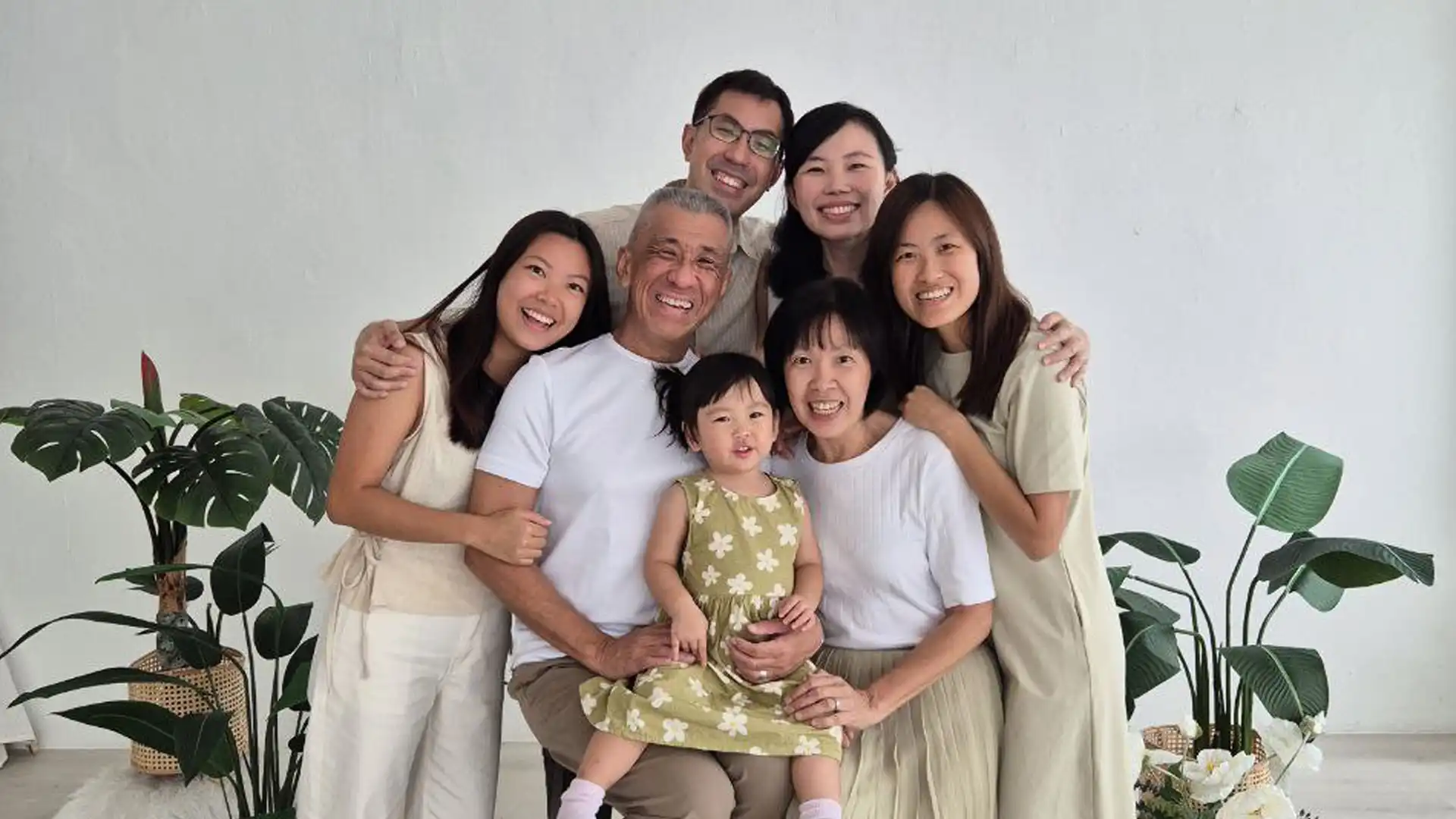
“Congratulations, Grandpa Ho. Welcome to the club!”
With these well-wishes from brothers- and sisters-in-Christ, I was pleasantly inducted into the grandparents’ club on the day our first grandchild was born. My wife and I had long awaited this day.
As a family, we were overjoyed. After all, Proverbs 17:6 tells us that “children’s children are a crown to the aged, and parents are the pride of their children.”
As a grandfather of two, here are three biblical principles that have personally guided me in my role so far:
1. Rejoice
“Rejoice in the Lord always. I will say it again: rejoice!”
— Philippians 4:4
Our granddaughter was a miracle child. The gynaecologist had informed my son and daughter-in-law that she would have to undergo in vitro fertilisation (IVF) in order to have a baby. Not only would it have been a costly procedure, it would have been a stressful one for them with no guarantee of a successful pregnancy.
But, by God’s grace, when they returned to see the gynaecologist to start the IVF process, they found out that my daughter-in-law was already pregnant! As a father (and then soon-to-be grandfather), I rejoiced in God’s miraculous provision and blessing of my granddaughter, and gave all praise and glory to God whenever I recounted her birth to others.
I was particularly delighted when my son and my daughter-in-law presented our granddaughter for infant baptism. In our denomination’s tradition, infant baptism is a sign of parents pledging their responsibility to raise their children in the ways of the Lord (see Proverbs 22:6; Deuteronomy 6:1–9). After all, the Lord God in whom we believe is the God of Abraham, Isaac, and Jacob—He is the God of all generations.
2. Know Our Role
As grandparents, my wife and I are constantly mindful that we are not our granddaughter’s parents. We were intentional in preparing ourselves for our new roles by attending grandparenting courses conducted by a church and studying the Bible with other Christian grandparents in our small group. We also read books on the subject, such as A Grand Calling: Biblical Reflections for Grandparents by Robert M. Solomon.
Through these resources and fellowship with other grandparents, we’ve learnt the importance of our adult children assuming their role as parents, while we play our role by providing practical and timely support to their family unit. There are boundaries to observe so as not to conflate the roles.
A couple of instances would serve to illustrate the critical difference between the role of grandparents and that of parents:
Naming the Baby
In biblical times, names often reflected a person’s character and destiny. Abram, when called by God to be the father of all nations, was renamed Abraham (Genesis 17:5). Jacob, too, was renamed Israel after wrestling with God (32:28).
While grandparents may offer suggestions for choosing names based on meanings and the passing on of family traditions, the final decision belongs to the parents. We can discuss and pray over the choice of names but they, as parents, ultimately decide.
We’ve learnt the importance of our adult children assuming their role as parents, while we play our role by providing practical and timely support to their family unit.
For our grandchildren’s names, we discussed them as a family but left it to my son and daughter-in-law to choose their names. Our granddaughter—who is turning three soon—was named Jobelle, which means God is gracious; while our grandson—who is about five months old—was named after King Josiah, who “did what was right in the eyes of the LORD” and faithfully served Him all his days (see 2 Kings 22–23).
Parenting Preferences
Another area where we ought to defer to our children is when it comes to parenting methods and preferences. As grandparents, we can only share with our adult children our parenting experiences and pray that God would grant them wisdom in their parenting journey.
Yesteryear’s parenting styles may not be totally relevant in today’s context, wherein parents today tend to accord more autonomy to the child compared to previous generations that believe in establishing a more structured environment.
Let us seek God’s wisdom to discern and distinguish timeless parenting principles rooted in God’s Word from the trends of the day.
For example, when it comes to feeding at the table, some parents subscribe to baby-led weaning over traditional spoon-feeding, allowing the baby to feed himself or herself—and often messing up the dining area in the process. This can really irk some grandparents!
Let us seek God’s wisdom to discern and distinguish timeless parenting principles rooted in God’s Word from the trends of the day, and to prayerfully consider how and when to talk to our adult children about important principles, and when to give our children the space to explore and decide for themselves how they want to raise their children.
For example, we may gently remind our adult children not to discipline their children in anger (see Ephesians 6:4), but to correct them out of love and to restore them after the disciplining episode.
My wife and I also pray over any issues or concerns we have—both for and with our adult children. We also set aside time to discuss with our children the issue at hand, by better understanding their preferences and motivations, and respectfully sharing our views on the matter. This way, we can prayerfully pre-empt any potential disagreements that might arise.
3. Live Out Our Responsibilities
As grandparents, we play an important part in our grandchildren’s spiritual growth. As Psalm 145:4 exhorts us: “One generation commends your works to another; they tell of your mighty acts.”
For my wife and I, this means that we seek to . . .
- Pray unceasingly (1 Thessalonians 5:17). Not only do we pray for our grandchildren, we also pray for our adult children to abide in Jesus always, for it is only when they abide in Him that they can be fruitful in all that they do as parents (John 15:4–5). With parenting comes many unanticipated challenges—and this means that our adult children need the grace and wisdom of God to do the right thing at every stage of their child’s development.
- Continue gathering as a family on a regular basis. In our family, we have the tradition of meeting for a weekly family meal and prayer. The addition of young grandchildren may disrupt this routine, but we persevere to meet as a family for bonding and prayer, so that we can “spur one another on towards love and good deeds” (Hebrews 10:24). Coming together may not be easy, but every gathering is always rewarding.
- Bring up our grandchildren in the ways of the Lord. The best gift we can offer our grandchildren is to lead them into God’s kingdom and nurture them to be disciples of Christ. Timothy was one such person to benefit from the nurturing of his mother and grandmother (2 Timothy 1:5). As grandparents, we have this great privilege and opportunity.
A Grand Calling
These days, we have a routine after we fetch our three-year-old granddaughter from her preschool in the evenings. After sanitising her hands, we say a short prayer with her before letting her enjoy her favourite snack.
Recently, when my wife prayed a longer prayer than usual, our granddaughter chirped, “Nai Nai (Chinese for grandmother), can you pray faster so that I can eat?” This was much to our amusement and laughter.
Aside from our daily prayers with her, we also taught her to memorise and recite the Lord’s Prayer and John 3:16. Don’t be surprised—young children have excellent memory. (After all, our granddaughter is taught the national anthem and pledge in preschool, both of which she can sing and recite respectively—though more than a little imperfectly!).
A brother-in-Christ once jokingly remarked: “Grandparenting is grand because it requires a grand amount of time, grand energy, and grand efforts.” How true indeed!